
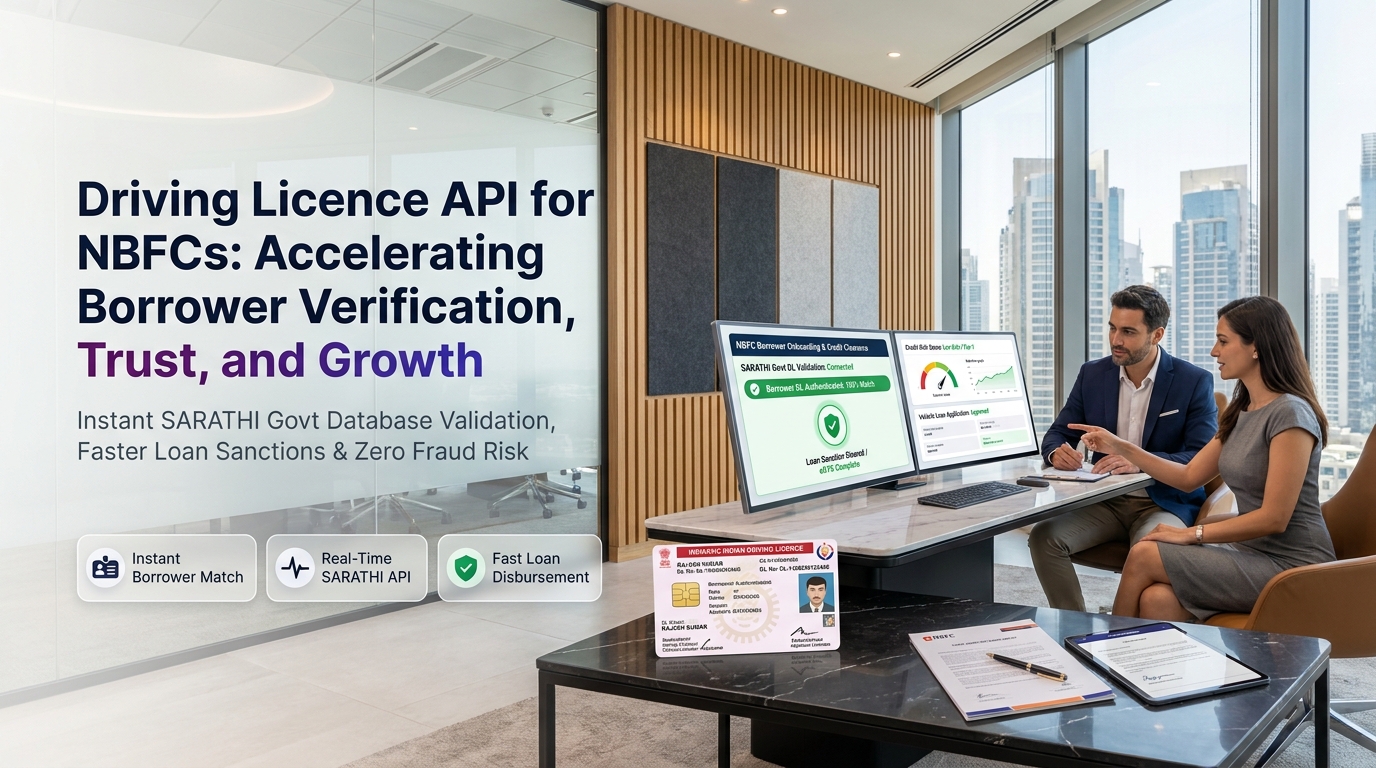
Driving Licence API for NBFCs: Accelerating Borrower Verification, Trust, and Growth
There's a branch manager in Nashik I think about whenever this subject comes up. Two-wheeler finance, the kind of NBFC branch that sits next to the dealership and writes loans while the customer is still deciding on the colour. I spent a day there watching files move, and what struck me wasn't the volume. It was the plastic folder.
Every applicant handed over a folder of photocopies, and the branch staff performed the same ceremony each time: hold the driving licence copy up, look at the applicant, look at the copy, nod. That nod was the identity verification. I asked the manager what the nod actually confirmed, and to his credit he laughed. "That the photo has a face in it, sir. What else can I check?"
He wasn't being lazy. He was being honest about the tools. A photocopied licence tells a branch officer nothing that matters: not whether it's real, active, suspended two years ago, or edited in a photo shop above the tea stall. His head office fixed the tool problem eighteen months ago by wiring a driving licence API into the loan origination app: licence number typed in, consent taken, the record itself answering in three seconds.
The manager's review of the change is my favourite vendor testimonial ever collected: "Earlier I approved faces. Now I approve records."
Why the licence is the NBFC document
Banks lean on PAN. NBFCs, especially in vehicle and small-ticket lending, meet the driving licence far more often, and the reasons are practical. Their borrowers are riders and drivers, so the licence is the card in the wallet. Their products, two-wheeler loans, used-car finance, commercial vehicle loans, involve driving by definition, so the licence is both identity document and eligibility proof in one. And their customers skew toward thin-file, first-time borrowers, where every extra document demanded is a customer lost to the dealer across the road.
That last point deserves respect. In dealership finance, speed is the product. The customer is standing at the counter, the competitor's executive is ten feet away, and the NBFC that says yes in twenty minutes wins the file. Driving licence verification for NBFCs isn't a compliance nicety in that setting, it's the difference between verifying the borrower and losing the borrower.
What changes with the API
A driving licence verification API call does at the counter what head office could never do from a photocopy: confirms against issuing records that the licence exists, is active, and matches the name and date of birth on the application. The driving license verification API returns status, validity dates, and vehicle classes, which matters more than people notice, a commercial-vehicle loan to a borrower licensed only for two-wheelers is a problem worth catching at origination, not at the first claim.
The Nashik branch's numbers, as the manager tells them: file processing at the counter dropped from around forty minutes to under fifteen, and the branch caught eleven bad licences in the first year, two forged outright, the rest expired or suspended. Eleven doesn't sound dramatic until you remember each one was previously getting a nod. The fintech version of this story is about app funnels; the NBFC version is about a counter and a queue, but the mechanics are identical: a driving licence eKYC API for NBFCs replaces judgment about paper with facts from records.
One caution, repeated across this whole series because branches keep making the same mistake: an expired licence is not fraud. It's usually a renewal someone forgot, especially among honest rural borrowers. The check surfaces the fact; the branch officer asks the question. NBFCs that auto-reject on any flag hand good customers to whoever is less careless next door.
Building it into the NBFC stack
A borrower verification API for NBFCs earns its keep only if it fits how NBFCs actually operate, which means three specific demands.
Branch usability first, the check must run from a phone or a counter terminal, the same requirement we set for RC checks at dealership counters.
Offline-tolerant workflows second, because dealership network connections are moody, the app should queue and retry rather than lose the application.
Back-book capability third: the first real project after integration is running the existing portfolio through the check, because the files approved by nods are still sitting in the book.
The compliance layer rides along as a by-product: consent captured at application, every response timestamped with a reference ID, logs exportable for the auditor, the discipline from our API security guide and consent notes. When partner banks or auditors ask how borrowers are verified, the answer is a report generated in minutes, a shift the FIDC, the NBFC industry body, has tracked as supervisory expectations keep tightening.
Selecting the best driving licence verification API for NBFCs follows the series checklist, distinct response states, month-end uptime, honest pricing clauses, with one NBFC-specific test: ask any driving licence API provider in India how they handle older licence formats, because an NBFC's borrowers carry documents spanning thirty years of issuing history across a dozen states, and the provider whose parsing chokes on a 1990s licence will choke at your busiest counter.
Conclusion
The plastic folders still arrive at the Nashik branch. The difference is what happens next: the licence number goes into the app, the record answers, and the nod has been retired.
A driving licence API for NBFCs is exactly that retirement, judgment about photocopies replaced by three-second facts, at the counter where speed wins files and carelessness writes losses.
Verify against the record, read the vehicle class, treat expiries as questions rather than verdicts, and log everything.
"Earlier I approved faces. Now I approve records." That's the whole business case, in the words of the man who runs the counter.