
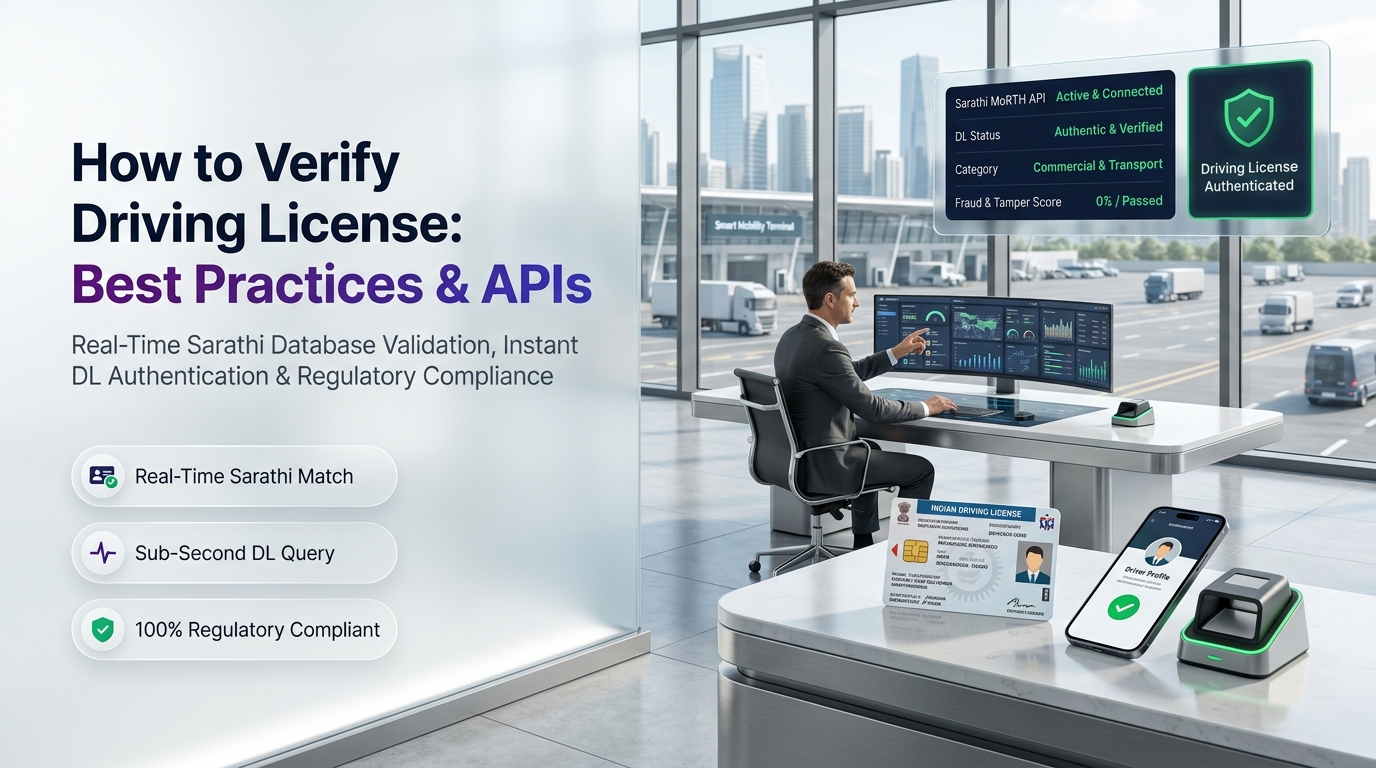
How to Verify Driving License: Best Practices & APIs
A fraud analyst at a consumer-lending fintech in Noida showed me a folder on her screen once. It held forty-one driving licences, all submitted as identity proof over one quarter, all fake, and all approved by her own company's onboarding team.
Nobody at the company had asked whether the applicants could drive. That's the point of this story. The licence wasn't there as a driving credential. It was there as an identity document, the second life this card lives in India, at lending desks, telecom counters, insurance forms, anywhere a customer is asked for ID and reaches for the wallet.
Her team had treated it like a photograph to be admired rather than a record to be checked, and forty-one invented people walked through the front door in three months.
"The funny part," she said, "is that we had an API for PAN. If they gave us a PAN, we checked it in two seconds. If they gave us a licence, a human squinted at a JPEG. The fraudsters figured out which queue to stand in."
That last sentence deserves to be printed on posters. Fraud flows to the unverified document, reliably, every time.
What Checking Actually Means
So, how to verify driving licence online when the licence is playing its identity role. The manual method, the squint, tests whether a card photographs convincingly. Modern fakes pass comfortably, templates are traded openly, and a good one is indistinguishable on screen from the real thing.
Online Driving Licence Verification through an API tests something else entirely: whether the record exists. Licence number to source records, back comes the holder's name, date of birth, validity, status. A fake card has no record behind it, so the check fails no matter how beautiful the JPEG. A real card borrowed from someone else fails the name match. An expired or cancelled licence shows its status. Seconds, not squinting.
For identity work, the response fields matter differently than for fleets. A trucking company cares about vehicle classes, our fleet management post covers that side. A lender doing Driving Licence verification for digital KYC cares about name and date of birth, because those two fields anchor the customer file. If they verify, the file stands on record-backed ground. If they were never checked, the file stands on a JPEG.
Best Practices, From the Cleanup
The Noida fintech rebuilt after the forty-one. What follows is their sequence, which I've since recommended to a dozen businesses using licences as ID.
Parity between documents came first. One rule: any document accepted as identity proof gets a source-record check, no exceptions, no favourite queues. The day a Driving Licence API for identity verification went live next to the PAN rail, the fraudsters' arbitrage vanished.
Applications using licences dropped noticeably in week one, which told everyone what share of that queue had been synthetic.
Second, name-match discipline. The API returns the registered name; the flow compares it against the application name. Sounds trivial, but the original process had a human doing this by eye, and humans get generous by mid-afternoon. The rebuilt flow used fuzzy matching with a review lane for genuine variants, initials, transliterations, and a hard stop for the rest.
Third, they extended the check to the existing book, not just new applications. Every live account that had onboarded on a licence got swept through the Driving Licence verification API for businesses in overnight batches. Most cleared. A small cluster didn't, and some of those were already showing early payment stress.
The risk head:
"The bad documents and the bad loans were the same accounts. We'd been discovering it in collections instead of onboarding."
Results, rounded, one company. Synthetic-identity approvals through the licence route went to zero the quarter the rail went live, against forty-one the quarter before. Onboarding time for honest licence-holders dropped from a day to seconds, same pattern as every queue-versus-check story we've told, including our PAN verification for fintech post.
And the compliance file got simpler: one standard of evidence across all identity documents, which is exactly what an auditor wants to find. Industry bodies like NASSCOM keep repeating that digital finance scales on verifiable trust rails, and the licence rail was the one this company had left unbuilt.
Choosing the API
Buying notes, short and opinionated.
Response completeness first. For identity work you need name and date of birth in the response, not just a valid/invalid flag, because the match against your application data is the entire product. Ask for a sample response before anything else. The Best Driving Licence Verification API shows full fields, clearly structured, with old licence formats handled.
Coverage second, every state, old formats included. Then latency inside your onboarding flow, percentiles at load, in writing. Then batch capacity for sweeping your existing book, because if the Noida story teaches anything, it's that the stock matters as much as the flow. A Driving Licence verification API for enterprises should quote both paths without hesitation.
And the rails underneath: consent captured in-flow, purpose logged, queries auditable, per our consent notes and API security guide.
Any Driving Licence Verification API provider in India serving regulated customers should walk you through the audit trail unprompted.
The afternoon test, as always: twenty licences you know, including a fake if you've kept one from a fraud file. The API finds them or it doesn't.
-
Conclusion
Forty-one invented people in one quarter, through the one document nobody checked.
Driving Licence Verification in its identity role isn't about roads or vehicles at all; it's about whether the name and birth date at the bottom of a customer file connect to a real record or to a well-made image.
The check takes seconds and costs less than the squint it replaces.
Fraud flows to the unverified document, so the practice worth adopting is the Noida rule: every document you accept, you verify, same rigour, same speed, no favourite queues.