
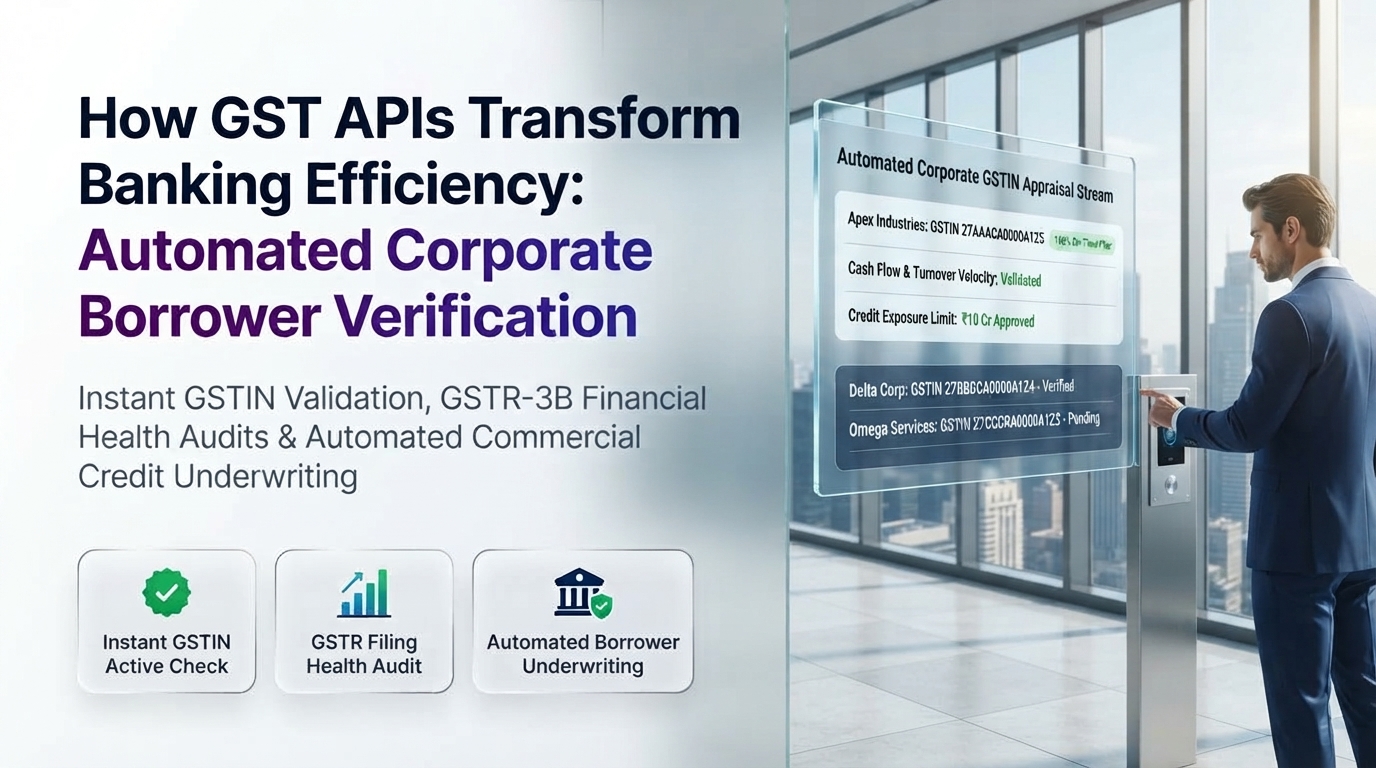
How GST APIs Transform Banking Efficiency: Automated Corporate Borrower Verification
A credit analyst at a private bank once described her Mondays to me, and I've repeated the description in every working-capital conversation since.
Monday was "statement day." Corporate borrowers seeking working-capital limits would send in their turnover figures, and her job was to believe or disbelieve them. The tools available: audited financials that were eight months old, bank statements that showed money moving but not why, and the borrower's own word, presented in a nicely formatted table. She had a whole ritual, she said, of comparing the table to the statements and looking for the seams. Some Mondays she found them. The ones she missed became someone else's problem, eighteen months later, in the recovery department.
Then her bank wired a GST API into corporate onboarding, and Mondays changed shape entirely.
Here's the part that matters: a business filing GST returns is describing its actual sales, month by month, to the tax system, and lying there has consequences most promoters won't buy. So when the borrower's claimed turnover and the GST-reported turnover sit side by side on her screen, the seams stop hiding. She told me the first month was "a bit of a massacre." Three limit applications quietly withdrawn after the bank asked follow-up questions. Now word has gotten around and the tables that arrive on Mondays have become strangely accurate.
What the API actually returns
Strip the jargon and a GST verification API does two jobs for a bank.
Job one, identity and status. Feed it a GSTIN and the GSTIN verification API returns the registered legal name, trade name, registration status, active, cancelled, suspended, taxpayer type, state, and registration date. Thirty seconds against the live record, versus the old way, which was a photocopied certificate that proved only that the borrower owned a photocopier. We covered the structure of the GSTIN itself, the state code, the embedded PAN, in the e-commerce GST post; the same fields do heavier lifting in banking, because here the number isn't decorating an invoice, it's anchoring a credit exposure.
Job two, and this is where lending decisions actually move: with the borrower's consent, filing and turnover data. Whether returns are filed on time, how reported sales trend month over month, whether the business that claims fifty crores of annual turnover reports anything like it. GST verification for businesses at this depth turns the flat photograph of an annual audited statement into something closer to video.
GST API for banks, in the credit file
Let me walk through where the Gujarat-headquartered bank I mentioned actually uses it, because placement is everything.
At onboarding, the GST API for banks runs with the other KYC checks, the PAN verification sister check among them. Cancelled or suspended registrations stop the file immediately. That's the cheap catch, and it happens more than you'd think with shell entities.
At appraisal, the analyst puts claimed turnover against GST-reported turnover. Perfect matches are actually rare and nobody expects them, timing differences and exempt supplies create honest gaps. What she's reading is the size and direction of the gap. Ten, fifteen percent, explainable, ask and move on. Forty percent, sustained, with returns filed late three months running, that file earns a site visit. GSTIN verification API for corporate borrowers work isn't a verdict machine, it's a question-sharpening machine, and sharp questions are most of what credit analysis is.
On the live book, the bank reruns filings quarterly on its working-capital portfolio. A borrower who stops filing GST returns has usually stopped a lot of other things too, and that signal arrives months before a default does. Their risk head calls it the cheapest early-warning system the bank owns, which matches what we found with challan spikes in the NBFC post: the operational data always talks before the repayment data does.
One discipline note, non-negotiable in banking: consent for the data pull, captured and logged, every response timestamped with a reference ID, retention rules enforced. The standards in our API security guide apply at full strength, because this is commercially sensitive data and an audit will eventually ask who saw it and when.
What changed operationally
The honest before-and-after, from the analyst's desk. Appraisal turnaround on working-capital files dropped from about two weeks to four days, most of the gain from no longer chasing documents that the API now fetches in seconds. Her Monday ritual still exists, but it starts from verified numbers, so her judgment goes into interpreting gaps instead of hunting for them. Automated GST verification for banks didn't replace her, it promoted her, from document-checker to actual analyst, and she'd be the first to say the job got more interesting.
Sector-wide, this is the direction everything is moving. The Indian Banks' Association has pushed members toward straight-through corporate onboarding for years, and GST API for corporate borrower verification is one of the few pieces where the data is rich, current, consented, and already structured for machines.
Conclusion
The photocopied certificate era of corporate verification is ending, not because banks got stricter but because a better record became reachable. A GST verification API for banking puts the borrower's own monthly filings next to the borrower's claims, and the gap between the two is where credit risk was hiding all along. Verify the registration at onboarding, read the turnover gap at appraisal, watch the filing rhythm on the live book, log everything for the auditor. The analyst still has her Monday ritual. The difference is that these days, the seams she's looking for mostly aren't there, because everyone knows she can see.