
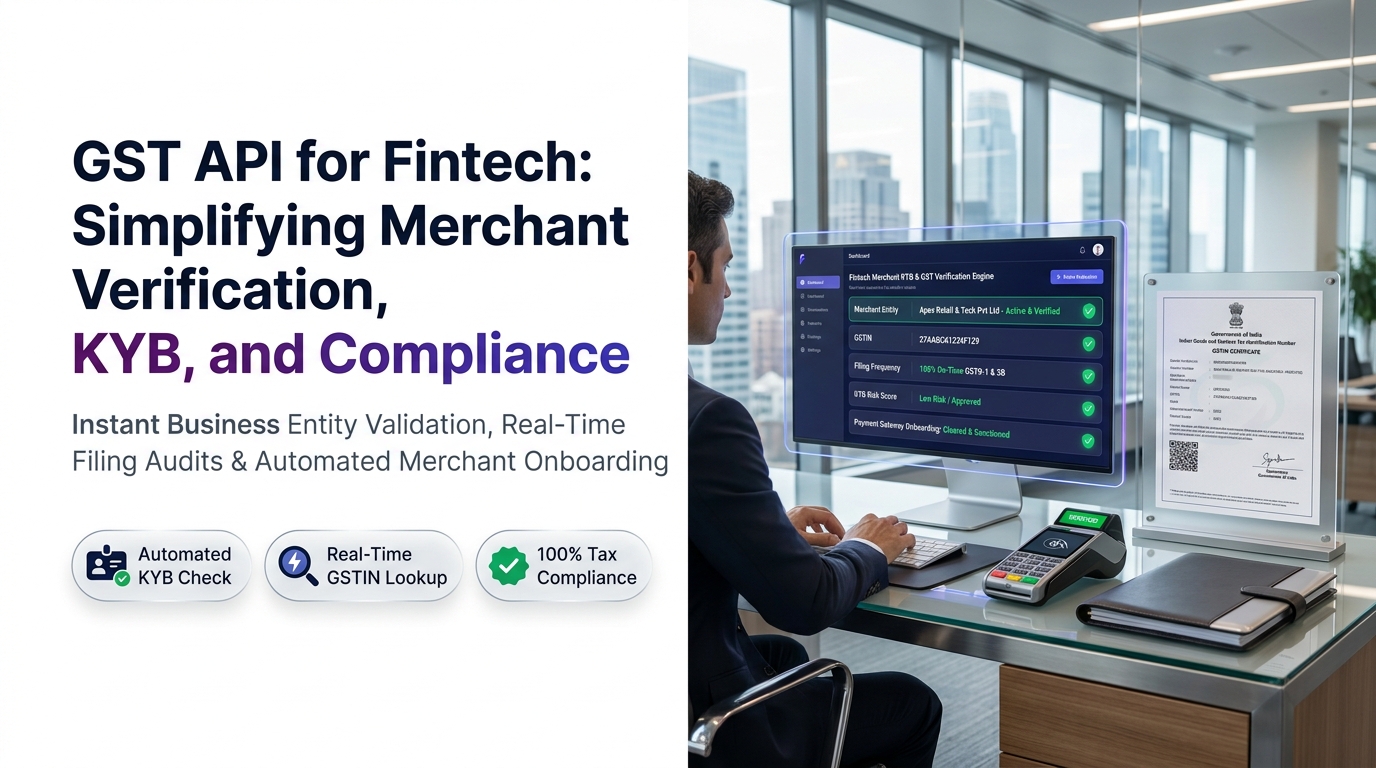
GST API for Fintech: Simplifying Merchant Verification, KYB, and Compliance
Forty-one percent.
A payments founder said that number to me across a dosa last year and then waited, the way people wait when a number is supposed to hurt. Forty-one percent of his merchant applications were blowing past the twenty-four-hour onboarding promise his sales team kept making. Competitors were signing the same shops in an afternoon. And when his team audited the stuck files, the cause was almost never risk. Risk would have been respectable. It was paperwork. A certificate photographed at an angle. A trade name that didn't match a legal name. A legal name that didn't match a bank account. Small honest businesses, tea stalls and textile traders, queuing because a human had to squint at documents before money could move.
His ops head said something in that audit meeting the whole company still repeats: "We're not running risk checks, we're running a photocopy museum."
I've told that line to a dozen onboarding teams since. Half laughed, then went quiet, because they recognised the museum.
Why the GST record fits merchant KYB
KYB is KYC's harder sibling, and people outside the trade rarely appreciate how much harder. An individual is one identity to verify. A business is four questions stacked up. Does it exist? Is it active right now? Is this person actually connected to it? Is it roughly the size it claims? The old answer to all four was: collect certificates. And certificates, as established, are where the forty-one percent went to die.
Now, one fifteen-character GSTIN. Feed it to a GSTIN verification API and back comes the legal name, trade name, status, taxpayer type, state, registration date. The GSTIN even embeds the business's PAN in characters three through twelve, one check corroborating another without anyone asking, a quirk we unpacked in the e-commerce GST post. Most of the KYB skeleton, one consented call.
The field I'd tell you to stare at is registration date. Nobody talks about registration date. A "wholesale electronics trader" with a six-week-old registration asking for a five-lakh daily settlement limit is not the same merchant as one registered in 2019, whatever their websites look like. Fraud rings mint fresh entities the way the rest of us mint UPI handles. Fresh shows in exactly one field, and most onboarding flows don't even display it.
GST verification for merchants, in the real flow
What his flow looks like now, in order, because the order is the design.
Merchant types a GSTIN into the app. Before they've finished the rest of the form, the GST verification API has already fired. The legal name comes back on screen, "is this your business?", and the merchant confirms. That one screen kills typos dead. Status: active, carry on. Cancelled or suspended, polite decline with the reason attached. The legal name then goes against the settlement account through a penny drop check, because a verified business settling into an unverified account is half a check. Composition-scheme merchants get flagged and handled per policy. Under a minute, start to finish, and the merchant's total effort was typing one number they know by heart.
The backlog? His words: "a single-digit number I've stopped checking daily." The museum staff didn't get fired, they got promoted into exceptions, name mismatches, fresh registrations, records that contradict forms. Machine reads the record, human reads the exceptions. There is no more architecture to GSTIN verification API for merchant onboarding than that, and I've grown suspicious of vendors who claim there is.
Lending-adjacent fintechs push one layer further. With consent, a GST API for KYB verification reads filing regularity and reported turnover, and merchant KYB stops being a gate and becomes an underwriting input. Banks made the same move on corporate borrowers, see the corporate borrower post, fintechs are just making it at higher volume with smaller tickets.
The compliance half
Founders find this half boring. Their partner banks do not, and the partner bank's opinion wins, because its licence sits behind the product. Automated GST verification for fintech compliance mostly means this: every check logged, timestamp, reference ID, stored response, recorded consent, at a volume where logging must be structural. Thousands of merchants a month do not get logged by good intentions.
When the partner bank audits onboarding, the evidence is a report generated in minutes. When a merchant goes bad despite clean checks, and some will, the log proves the fintech did what its policy promised on the day. That's the line between an incident and a liability. Standards are the usual API security guide set. Wider context, the Payments Council of India publishes regularly on merchant digitisation.
On picking the best GST verification API for merchant verification: the series checklist applies, distinct response states, congestion uptime, honest pricing, exportable logs, plus one thing specific to this use case. Latency. The merchant is standing inside the flow while your check runs. Ninety seconds is fine in a bank's back office. In a merchant app it's an abandoned application and a shop signed with your competitor by evening. A GST API that can't answer in seconds isn't a fintech product, whatever the brochure says.
Conclusion
The photocopy museum closed and nobody has visited since. One field, one minute: GSTIN in, name confirmed on screen, status checked, account matched, exceptions routed to people, everything logged as a by-product. That's GST verification for merchants working properly, and it's the whole promise of a GST API for fintech: the record was always there, current and structured and consented, waiting for someone to stop collecting paper and start reading it. For every GST verification API for fintech companies pitch I've sat through since, that's still my first question: which number of yours is secretly a paperwork number? Most teams have one. His was just honest enough to measure it.