
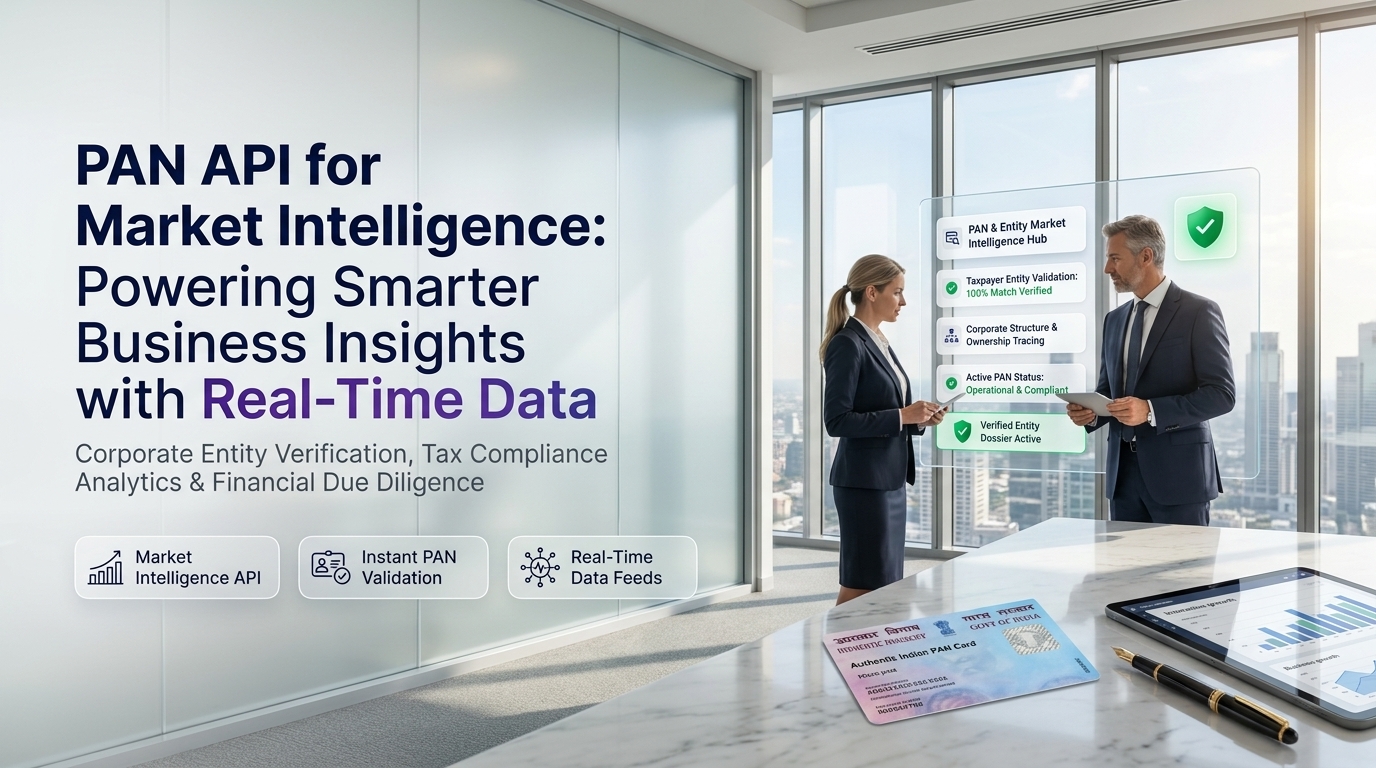
PAN API for Market Intelligence: Powering Smarter Business Insights with Real-Time Data
In 2023 a B2B software company asked me to look at their sales data before a funding round. Their pitch deck claimed twelve thousand business customers. The diligence team wanted the number verified, and verification produced a smaller number: roughly nine thousand distinct businesses.
The other three thousand records were duplicates wearing disguises. The same firm entered as a private limited, as its trading name, and as its founder's proprietorship. Three sales reps had each "won" the same customer in different quarters. Territory reports, expansion plans, and churn calculations had been built on all twelve thousand for two years.
The instrument that found this was unglamorous. Every customer record carried a PAN, collected during onboarding for invoicing. Running those PANs through a verification flow returned the registered name and status for each, and matching registered names across the file collapsed the duplicates in an afternoon.
Nobody had ever read the file that way. The PAN had been treated as a tax field, something to print on invoices. It turned out to be the only reliable key the dataset had.
That's the case this post makes: a PAN API is usually bought for compliance, but the same record, used at file scale, is market intelligence infrastructure. Companies pay for third-party firmographic data while sitting on an unread version of it in their billing systems.
What the Record Gives You, at File Scale
The mechanics first.
A PAN verification API takes a PAN, with proper consent and purpose, and returns the registered name and card status from the issuing records. Valid, invalid, inactive.
Our banking PAN post covers the KYC use, one query at a time, one decision at a time.
Used as a PAN data API across an entire customer or vendor file, the same response answers different questions.
How many distinct entities do we actually serve? The question that cost the software company three thousand phantom customers.
Which records are stale? An inactive status on a business PAN signals an entity that folded or restructured, and it usually reaches the record before it reaches your receivables.
Which "different" counterparties are related? The same registered name behind multiple trading names is either a group structure worth knowing or a concentration risk pretending to be diversification.
We saw the identical pattern with vehicle records in our enterprise RC post: a compliance dataset, read at scale, becomes a census.
PAN API for market intelligence is the entity-side version. The vehicle record tells you what your customers drive. The PAN record tells you who they legally are, and both decay silently unless refreshed.
Three Uses I Have Seen Pay for Themselves
1. Sales and Account Intelligence
First, sales and account intelligence.
The cleanup changed more than the customer count. Deduplicated accounts ended territory disputes, cross-sell lists stopped containing the same firm twice under two names, and the renewal team discovered that what looked like three small accounts churning was one mid-sized account consolidating.
PAN API for business insights here means nothing more exotic than knowing your customer base's real shape.
Their CRM now verifies at entry, cheapest at the door, and the corporate vendor post walks that discipline for supplier files.
2. Partner Risk as a Market Signal
Second, partner risk read as a market signal.
A distributor I worked with runs quarterly refreshes on its dealer network, several thousand PANs, through an enterprise PAN verification API with batch support.
Status and name changes get flagged. One quarter the refresh caught eleven dealers whose registered details had changed without notice, mergers, closures, one quiet ownership transfer.
Sales planning treated that as intelligence, not compliance: territories were redrawn before the changes hit order volumes.
A PAN verification API for market intelligence works exactly there, in the gap between when reality changes and when your revenue notices.
3. Segmentation That Holds Up
Third, segmentation that holds up.
Firmographic vendors sell segment data of uneven quality. The registered name in the PAN record, matched against your transaction history, gives a verified spine to hang segmentation on.
One industrial supplier rebuilt its account tiers after deduplication and found its "long tail" of small buyers was a third shorter than reported, with the volume actually concentrated in groups buying through multiple entities.
Pricing negotiations changed accordingly.
That insight was sitting in their own invoices, unlocked by PAN API for real-time data checks that cost less than one conference pass.
Consent, Purpose, and Data Governance Matter
The boundaries matter and I state them in every engagement.
Consent and purpose limitation are not decoration: data collected for invoicing cannot be quietly repurposed without a lawful basis, the ground covered in our consent notes, and every query needs the logging discipline of the API security guide.
Intelligence built outside those rails is liability, not insight.
Industry bodies like NASSCOM have argued for years that India's data economy depends on exactly this kind of governed, consented use.
Choosing One for Intelligence Work
The evaluation differs from a KYC purchase.
Batch Throughput Comes First
Refreshing a fifty-thousand-record file quarterly is a pipeline job, so ask any PAN API provider in India for full-file economics rather than per-call pricing.
Name Matching Must Handle Variations
Name matching must return scores, because trading names and registered names diverge constantly, and exact matching would merge nothing and flag everything.
Clean Data Delivery Matters
Output must land in a warehouse cleanly.
Status History Adds Context
Status history helps. A record that went inactive last quarter tells a sharper story than one that is merely inactive today.
The best PAN API for market intelligence is the one your analysts can schedule and your auditors can trace, and it is usually the same product sold as compliance tooling, bought with different questions in mind.
Conclusion
Twelve thousand customers became nine thousand real ones in an afternoon, and every number downstream of that count got more honest.
That is the quiet promise here.
A PAN API verifies identities one at a time for compliance, and the same record, refreshed and read across a whole file, tells you what your market actually looks like: how many entities, which ones are related, which ones are fading, where the concentration sits.
Verify at entry, refresh on a schedule, respect consent, log everything.
The most underpriced market intelligence in most companies is the tax field they already collect.