
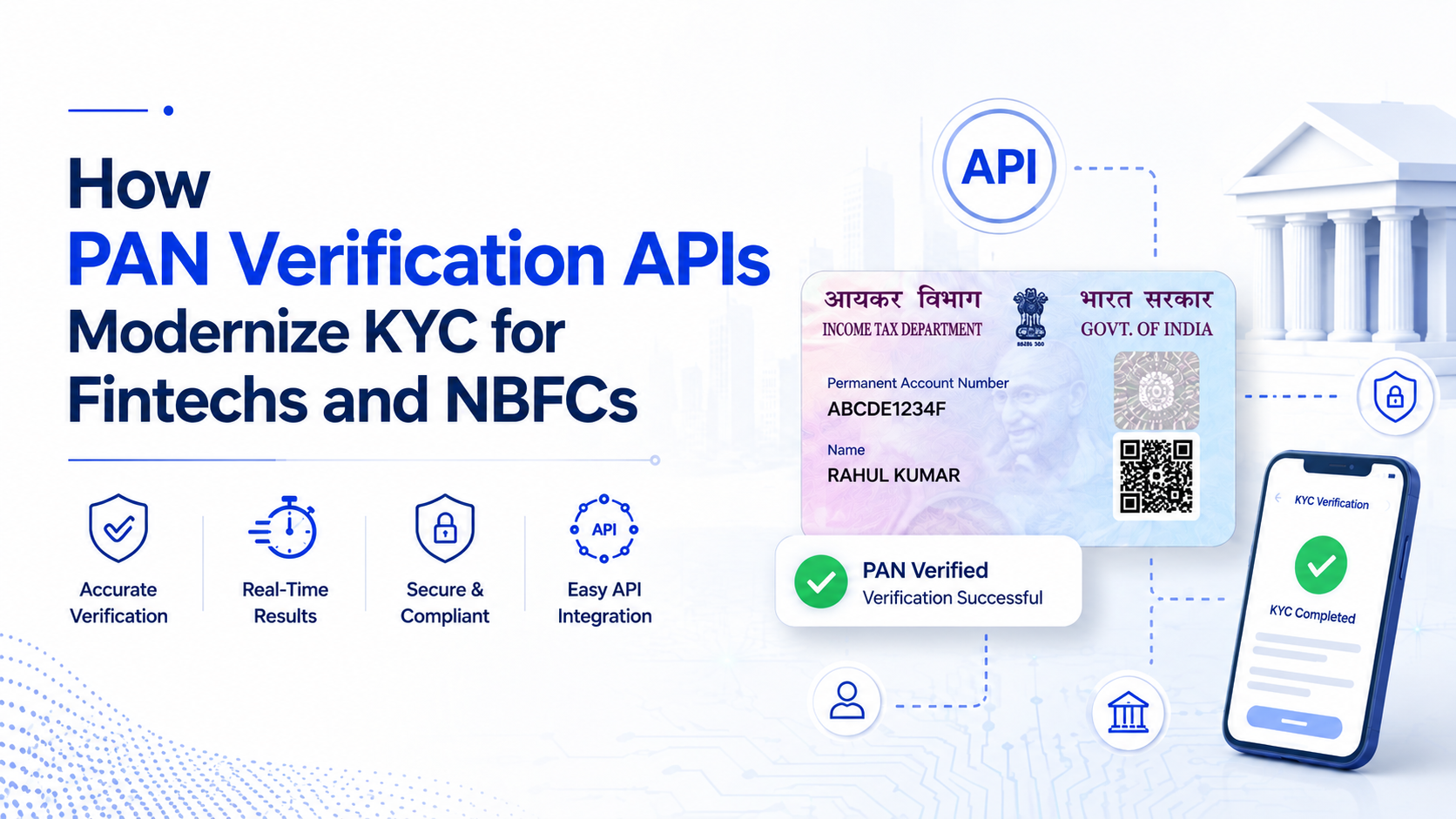
Ask anyone running onboarding at a fintech what keeps them up at night, and "drop-off rate" comes up fast. Not fraud, not compliance fines — drop-off. Because if your KYC step takes too long, people just leave. They don't file a complaint. They close the tab.
That's the uncomfortable reality NBFCs and fintechs are dealing with right now. Verification has to be airtight, but it also can't feel like a hurdle. And honestly, for a long time, those two goals fought each other.
PAN Verification APIs are one of the few things that actually resolve that fight instead of just compromising between the two.
Why PAN Even Matters This Much in KYC
Here's the thing about PAN it's not just a tax number sitting in a drawer somewhere. It's become one of the more reliable identity anchors in Indian finance. The Income Tax Department maintains its own verification service for checking name, date of birth, and active status against a PAN, and external agencies can plug into that too, assuming they've got the right approvals.
Why bother checking it early? Because a mismatched name or an inactive PAN caught on day one is a five-minute fix. Caught three steps into a loan application, it's a mess and usually a customer you've already annoyed.
Okay, But What Actually Is This API?
No mystery here. A PAN Verification API takes the details a customer enters, sends them off to a verification service, and gets a structured answer back. That's it. No one on your team is manually squinting at a database entry.
Roughly:
Customer types in PAN → API sends it off → verification happens → answer comes back → onboarding keeps moving
Drop that into a loan app, an account opening flow, insurance sign-up, whatever same mechanism, different wrapper.
Fintechs Live and Die by Speed This Helps There
Fintechs don't really compete on interest rates or product features half the time. They compete on how painless the experience is. A customer expects to apply for something and have it feel instant, not like a trip to a branch in 2009.
Cut the manual review out of PAN checking and you get consistency too the process doesn't degrade whether you're handling fifty applications a week or fifty thousand. A lending platform, for instance, can fire off verification the second someone submits their form. Passes the rules? Straight to the next stage. No one had to lift a finger.
NBFCs Have a Slightly Different Problem, Same Solution
NBFCs aren't chasing speed in quite the same way they're managing scale across lending, onboarding, and ongoing compliance all at once, often for a much bigger and more varied customer base. A solid PAN Verification API gives that whole operation something to lean on, structurally.
Worth flagging: RBI's KYC framework actually requires regulated entities to verify identity through independent, reliable sources, and PAN checks are explicitly part of that. None of this means the API takes compliance off your plate, though. It's a tool sitting inside your risk framework not a substitute for having one.
What You Actually Get Out of This
Faster onboarding, obviously cutting manual review time shows up immediately in how quickly someone gets through the funnel.
Fewer dumb errors too. Anyone who's typed a ten-digit number for the hundredth time in a shift knows how easy a typo slips through. Automating that step just removes the opportunity for it.
Then there's scale. Checking a hundred applications by hand? Fine. Checking ten thousand? You'd need to hire your way out of that problem instead of engineering your way out of it, which is the wrong direction to be going.
There's also the human side of it your team stops babysitting routine checks and starts actually looking at the applications that need judgment, not rubber-stamping.
And integration tends to be less painful than people expect. Most decent PAN APIs slot into whatever loan origination system, CRM, or onboarding stack you're already running, though obviously that depends on the provider.
PAN Verification Doesn't Work Alone
Nobody's KYC process is just PAN verification anymore. It's a chain PAN, then identity checks, then address validation, then some kind of risk scoring, before anything actually gets approved.
Something like:
Onboarding starts → PAN check → identity verification → other KYC steps → risk assessment → approval
Strung together like that, the whole thing feels less like a scattered checklist and more like an actual system — which, frankly, is what regulators want to see anyway.
Before You Pick a Provider, Actually Check These
A lot of PAN APIs look identical on a sales page. They're not. Before signing anything, dig into:
Where the verification data is actually sourced from. How complete and accurate the responses are. Whether the documentation is any good, because bad docs mean weeks of back-and-forth with a support team. How fast it responds, and how often it's actually up. What happens to the data once it's sent. Whether it plugs into your existing stack without a rebuild. What the pricing looks like once you're past the free tier. And who's actually holding compliance responsibility you or them.
One more thing worth saying plainly: PAN verification is not the whole KYC process. It's a piece. Don't let anyone sell it to you as the finish line.
Where This Is All Heading
Digital finance isn't slowing down, and neither is the pressure to verify people faster without cutting corners. That's the tightrope every fintech and NBFC is walking right now.
A PAN Verification API doesn't solve KYC by itself nothing does, really but it plugs directly into the onboarding pipeline and takes a real chunk of friction out of it. Combine it with the rest of your risk and compliance stack, and you end up with something that actually scales instead of buckling under its own volume.
Bottom Line
PAN verification quietly became one of the backbone pieces of digital onboarding in Indian finance. Moving from manual checks to an API-driven approach isn't just about shaving off minutes it's about running things tighter and giving customers something that doesn't feel like a chore.
Just don't mistake it for complete KYC. It's one solid block in a much bigger structure.
Get that piece right, though, and the rest of your onboarding stack has a much easier time following.