
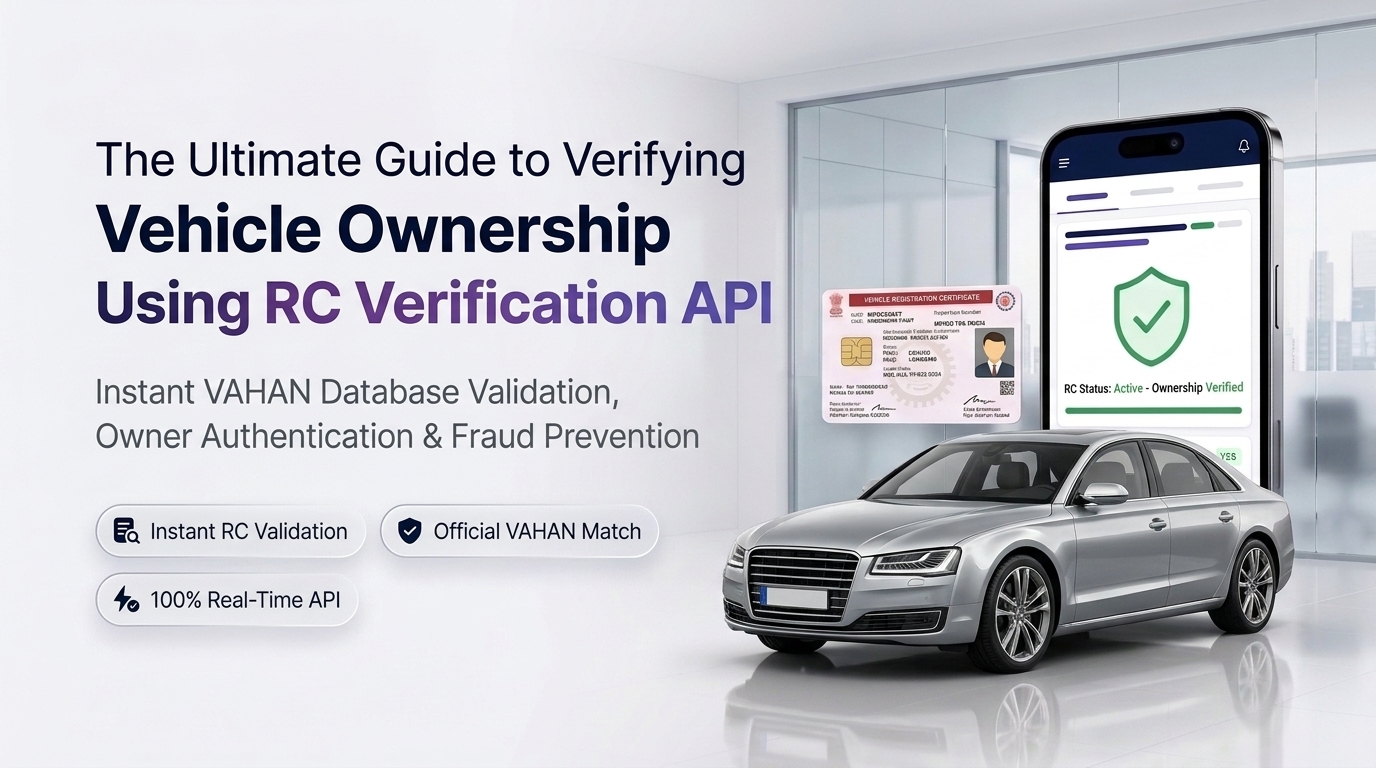
The Ultimate Guide to Verifying Vehicle Ownership Using RC Verification API
The dealer called me at 9:17 on a Saturday morning. I know the time because his voice message is still in my phone, and it goes, roughly: "You were right about that API thing. Don't ask me how, just come to the cabin."
So here's what had happened the evening before. He was twenty minutes from paying out on an Innova a customer had test-driven twice. One registered owner, or so the paperwork said, full service file, price settled. The seller was sitting in his office being charming. My friend had subscribed to a vehicle verification API a month earlier, mostly because I'd nagged him, and he'd run maybe three checks total. He ran the fourth one while they were negotiating the final number.
The record came back showing three owners. Three. The gentleman drinking tea in his cabin was not on that list under any name. The car had been sold twice without the transfer ever being processed, meaning the man about to pocket the cheque had no business selling it. When my friend pushed the laptop across the desk, the seller's reply was, and I quote, "Oh, that must be my cousin's." He left without the car and, importantly, without the money.
That phone call is why I tell people vehicle ownership verification isn't a compliance formality. Everything in that room said the deal was honest. The only thing that didn't say so was the registration record, and it took fifteen seconds.
What an RC verification API actually checks
Let me use that Innova to explain what the system even looks at. The RC, registration certificate, is the document that legally attaches a vehicle to its owner, and the card someone hands you can be real, fake, or merely out of date. You can't tell by squinting.
When he ran the check, the record came back with the registered owner's name (all three of them, in transfer order), the vehicle class, make and model, fuel type, registration date, tax and fitness validity, and the current status of the record. One field trips up even honest sellers: the hypothecation entry. Financed cars carry the lender's name as "HP" on the RC, and plenty of people finish paying the loan and never get it removed. The car is theirs. The paperwork says otherwise, which is a nasty surprise at resale. Spotting that is vehicle RC verification doing what no amount of document-gazing can.
How to verify vehicle ownership using RC verification API
People keep asking me how to verify vehicle ownership using RC verification API in a real transaction, so here's exactly what my friend's screen does. Whoever is handling the deal, buyer, loan officer, fleet executive, types the registration number into the system and consents to the check. The vehicle RC API returns the live record through an authorised channel. Then a human compares two things. Does the owner name match the person in front of them? Do the make, model, and fuel match the physical vehicle?
Both yes, proceed. Name mismatch, you stop and ask, which is not the same as refusing. I've watched mismatches turn out to be completely innocent, and this is the part inexperienced teams get wrong. A car registered to a parent that the son is selling for the family. A company vehicle an employee is handling on the firm's behalf. A sale agreed last week whose transfer is still in the queue. The Innova wasn't innocent, obviously. But vehicle owner verification only works because the check flags the gap and a person decides what the gap means.
Where else this shows up
Used-car deals are just the loudest example. A lender friend in Surat told me about a truck loan where the collateral was registered to the borrower's brother, which the RC verification caught before disbursement. Insurers run the check before issuing policies, because cover in the wrong name is a denied claim with extra steps. Ride-sharing fleets run it at driver onboarding so nobody lists a vehicle they don't own. The failure is always the same shape: somebody trusted a document that costs less than a chai to print.
Vehicle ownership verification using RC API: what good output looks like
One thing his old system got badly wrong: it just showed green or red. A red result has about a dozen different causes, each needing a different next move, so his team had started ignoring it. After they switched, responses came back as actual states, valid record, name mismatch, detail mismatch, no record found, expired, service unavailable, and each one routes somewhere sensible. That's what RC verification API integration should buy you, not a bigger checkmark. And because it's personal data, consent gets captured, every response is logged with a timestamp and reference, and reports stay need-to-know. Our consent management notes and API security guide cover the plumbing, the digital checks piece covers fleet-scale onboarding, and the market intelligence post covers what fleets do with vehicle data after ownership. The General Insurance Council has decent consumer-side guidance.
Conclusion
Vehicle fraud rarely announces itself. It shows up as a clean car, a polite seller, and paperwork one transfer behind reality. An RC verification API is the cheapest habit in the transaction: run the number, match the owner to the person, match the record to the vehicle, and put every mismatch in front of a human. Do that and vehicle ownership verification becomes the fifteen-second pause that keeps your chequebook in the drawer, which is exactly where my friend's stayed that Saturday morning.