
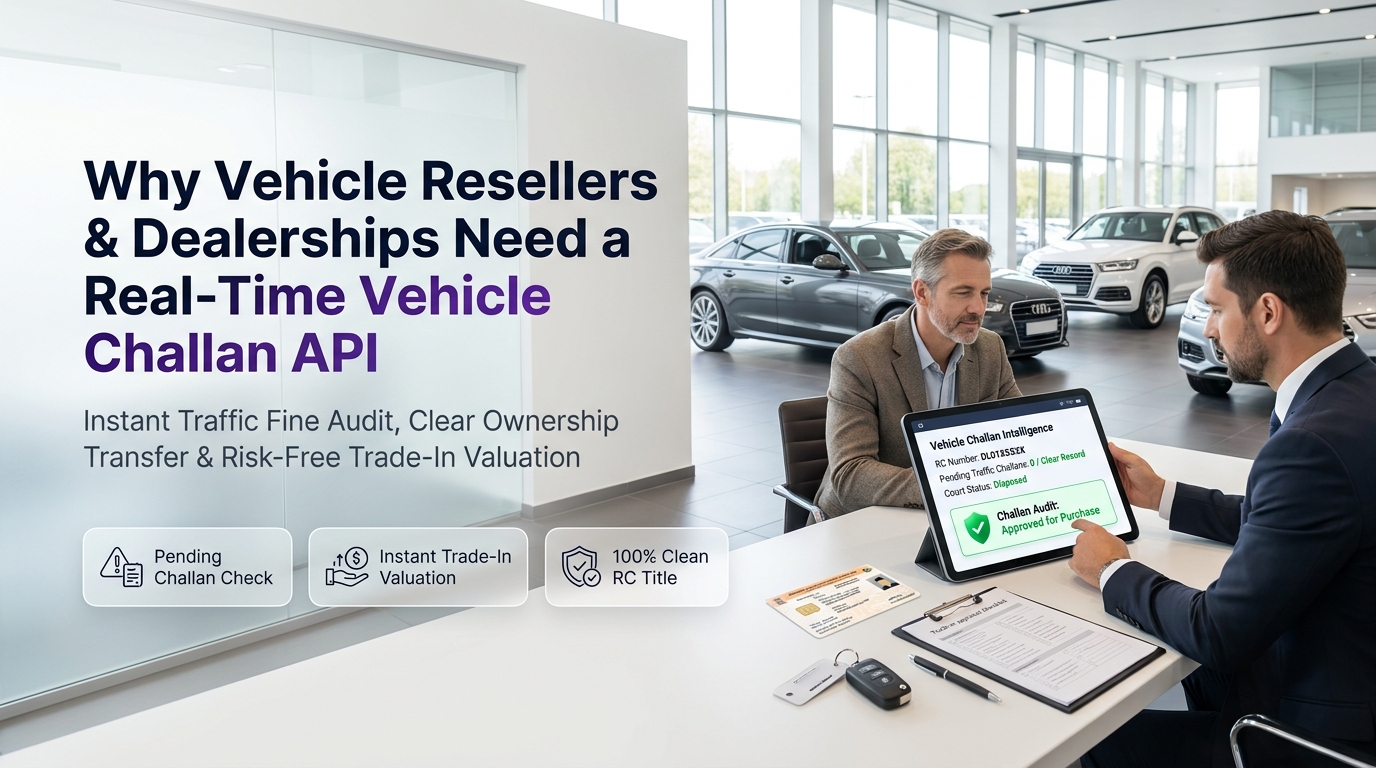
Why Vehicle Resellers and Dealerships Need a Real-Time Vehicle Challan API
A used-car dealer in Rajkot once showed me his version of a horror story. A hatchback, parked in the corner of his lot with a cover on it.
He'd bought it eight months earlier at a fair price, from a polite seller, with clean papers. Then a buyer's financier ran a routine check before disbursing the loan. The car carried pending challans worth more than the dealer's margin on it. Several were from a city the seller had never mentioned living in. The financier walked. Word got around, the way it does in a small market. The car sat.
"I checked the engine, the body, the service history," he told me. "I checked everything you can see. The problem was the thing you can't."
I've retold that story to maybe thirty dealers since, and every one nodded before I finished. Everyone in the trade has a covered car somewhere, or knows someone who does.
The Gap in How the Trade Buys
Watch a reseller evaluate a car and you'll see real skill. A repainted panel caught from across the lot, a tired clutch heard in one lap of the block. Decades of judgment, all aimed at the machine.
But a used vehicle is two things: a machine and a record. The machine you can inspect in an afternoon. The record follows its own life, and pending challans are its most slippery part.
They attach to the vehicle, pile up quietly, and surface at the worst moment, transfer time, loan time, resale time. A seller can be honest and still hand you a liability, because plenty of owners genuinely don't know what's pending against their own car.
A vehicle challan API closes that gap in seconds. Query the vehicle, get back pending challans, amounts, dates, places. Our post on vehicle APIs for dealerships covers the full stack, RC, insurance, financing checks.
The challan piece is the one dealers skip most, and it's the one that bites hardest, because it's pure money. Not a document mismatch you can fix with paperwork. Actual rupees owed, attached to an asset you just paid for.
And it has to be real-time.
A challan report from last month is a guess; violations don't wait for your purchase cycle. A real-time challan API answers about this morning, which matters when the seller is standing in front of you wanting a decision today.
That's why a real-time vehicle challan verification API beats any periodic report: the trade moves in hours, and the data has to move with it.
What Changed at One Dealership Group
The Rajkot dealer's group, four lots, maybe sixty cars a month, wired a vehicle challan API for dealerships into their purchase process. Their experience, numbers rounded, and typical of what I've seen elsewhere.
Every car gets checked twice. Once before the price is agreed, once on the day money moves.
The double check surprised me until they explained it: a fortnight can pass between handshake and payment, and challans don't pause for negotiations.
About one car in ten came back with something pending. Most were small, a few hundred rupees, and became a line item in the deal, seller settles or price adjusts.
That's the boring majority, and boring is the point. The check turned an invisible risk into an ordinary negotiation.
Twice in the first year it was not boring.
One vehicle carried a stack of violations suggesting a commercial past the seller had presented rather differently. They passed on the car entirely.
The purchase manager put it plainly:
"The challan history told me about the seller, not just the vehicle."
That's vehicle challan verification for resellers doing what no inspection can, reading character off a record.
The Downstream Effect
The downstream effect was the one that made the owner smile.
Cars now sell with a challan check done and shown, alongside the service history. Buyers' financiers stopped finding surprises, which means fewer collapsed deals at the disbursement stage.
Dealer bodies like FADA keep pointing out that trust is the used-car trade's scarcest commodity.
A challan API for used car dealerships is a small machine for manufacturing it, one clean report at a time.
Choosing One
What I tell dealer groups, in the order they get it wrong.
Speed and Uptime First
Speed and uptime first, because the check sits inside a live negotiation.
A result in seconds keeps the conversation moving; a result tomorrow means no check at all, humans skip steps that make them wait.
Coverage Across States
Coverage second: challans from every state, because used cars migrate and the nasty surprises usually come from somewhere else.
The best vehicle challan API for dealerships also pairs cleanly with RC and ownership data, the combination our fleet compliance post walks through, since a challan check without an ownership check is half an answer.
Consent and Auditability
Then the quiet requirements.
Consent captured, queries logged, the discipline in our consent notes.
Any vehicle challan API provider in India should show you an audit trail without being asked.
Test With Known Vehicles
My standard test fits in an afternoon: run ten vehicles you already know, including one with a history you've personally verified.
A vehicle verification API for resellers either finds what you know is there or it doesn't.
Ten cars settle it.
Conclusion
The covered hatchback eventually sold, at a loss, after the dealer settled the challans himself.
He calls it his tuition fee.
What he bought with it was a rule: no car enters the lot without a vehicle challan verification API check, same as no car enters without a test drive.
That's the whole lesson, honestly.
The trade already inspects everything it can see. The record is the part you can't see, and it's the part that carries the money.
Check it while the seller is still standing in front of you.