
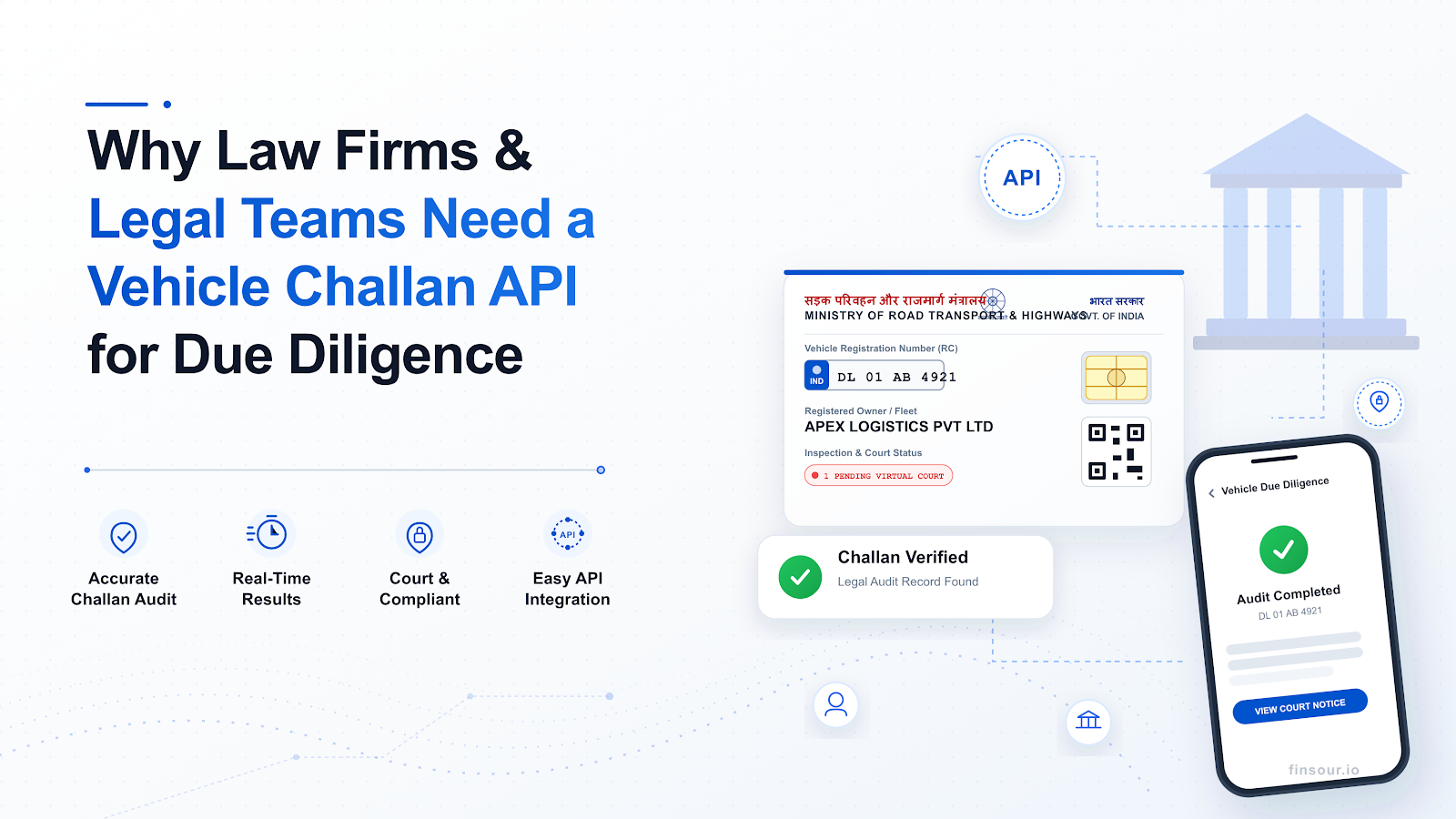
Why Law Firms and Legal Teams Need a Vehicle Challan API for Due Diligence
I want to tell this one carefully because I only know it secondhand, from the lawyer involved, and she tells it better than I do.
She's a disputes lawyer in Ahmedabad. We've worked together six or seven years, mostly when a matter has a data angle her team can't handle in-house. Last winter she called me about a settlement that had nearly gone wrong, or rather, had nearly gone through, which in this case was the same thing.
Her client was owed a fairly large sum by a transport contractor. The negotiation had dragged for months, and eventually the contractor offered part of the settlement in kind: his fleet. Eleven commercial vehicles. Both sides got valuations, the numbers were agreed, drafting had started. At that point most files are basically closed.
Her junior wasn't. Three years out of law school, and on a Sunday evening, without being asked, she ran all eleven registration numbers through a Vehicle Challan API. I asked later why the junior even thought to do it, and the answer was more or less: she didn't trust a man giving up his trucks that easily.
The result: a little under four lakhs in pending challans across the fleet. Mostly overloading cases, three states, some fines compounding since before the dispute began. Nobody on either side had checked. Her client was about to accept the vehicles at full price with four lakhs of somebody else's fines attached.
Monday morning she reopened the negotiation with a one-page annexure. The settlement closed with the challan amount deducted, and the junior, deservedly, had a very good appraisal that year.
Why enforcement history is a legal question
Here's what bothered me about the story, and still does a bit. The diligence on that settlement wasn't lazy. Ownership confirmed. Hypothecation checked. Valuations real. We covered that layer in our corporate due diligence post, and by that standard this file was clean. The four lakhs got through anyway, because every existing check pointed at one question, who owns this asset, and none at the other, what does this asset owe.
A vehicle carries both. There's the ownership history, and there's the enforcement history, and the second follows the vehicle regardless of what the transfer deed says or doesn't say. Vehicle challan verification is simply the reading of that second record: pending fines against a registration number, with amounts, dates, status, and the state that issued them. In a settlement, every pending fine is money your client is effectively paying. It should be on the table with everything else. Usually it isn't, because traditionally nobody's job was to put it there.
Where legal teams actually use the check
Settlements and attachments are the obvious place, but since that winter I've noticed the same check in other corners of legal work. A resolution professional I know runs a vehicle due diligence API across a debtor's fleet early in an insolvency, before bidders show up, because he'd rather discover the fines himself than have a bidder discover them for him. I've heard of it in estate matters, a contested vehicle carrying a year of unpaid fines neither heir wanted. And in transactions, where the target's fleet is part of the price, the fleet register and the actual records disagree more often than anyone expects.
One use surprised me. A litigator told me she'd used a fleet's challan pattern, hundreds of violations over two years, as supporting material in a negligence matter, to show how the operation was actually run day to day. The record worked well for that purpose because it's dated and official; there wasn't much the other side could say about it.
How to verify vehicle challans for legal due diligence
The method, for teams asking how to verify vehicle challans for legal due diligence, is short. Take the registration numbers from the schedule of assets or the draft. Run them through a vehicle challan check API, which returns per-vehicle results, count, amounts, dates, status. Then sort. Small amounts you ignore. Material amounts you price into the negotiation. And where the violations cluster in recent months, you ask questions, because a recent spike often means the asset is being run hard by someone who has mentally written it off already.
For legal work specifically I'd insist on two things. Timestamped, referenced responses from the vehicle challan verification API for legal teams, because the annexure may be exhibited and someone will eventually ask when you knew what. And a fresh run in the week of closing, since challans get paid and contested all the time and an old check proves nothing. Data-handling standards are in our API security guide, and the ownership layer this pairs with is in the RC verification guide. The Society of Indian Law Firms has published on technology-assisted diligence if you want the broader picture of where practice is moving.
On providers: the best vehicle challan verification API for law firms needs multi-state coverage, batch handling for schedules that arrive in dozens, and exports clean enough to attach to a filing. A vehicle challan API for law firms that only produces screenshots is not something you can build an annexure from, whatever else it does well.
Conclusion
The fleet changed hands at its true price, which is all diligence is for. The compressed version of the Vehicle Challan API for legal due diligence argument goes like this: vehicles keep two histories, legal practice has always checked the first, and the second costs a few rupees per number to read. In one settlement it was worth four lakhs. The junior who found it wasn't told to look. That, more than the API, is probably the thing to go and fix.