
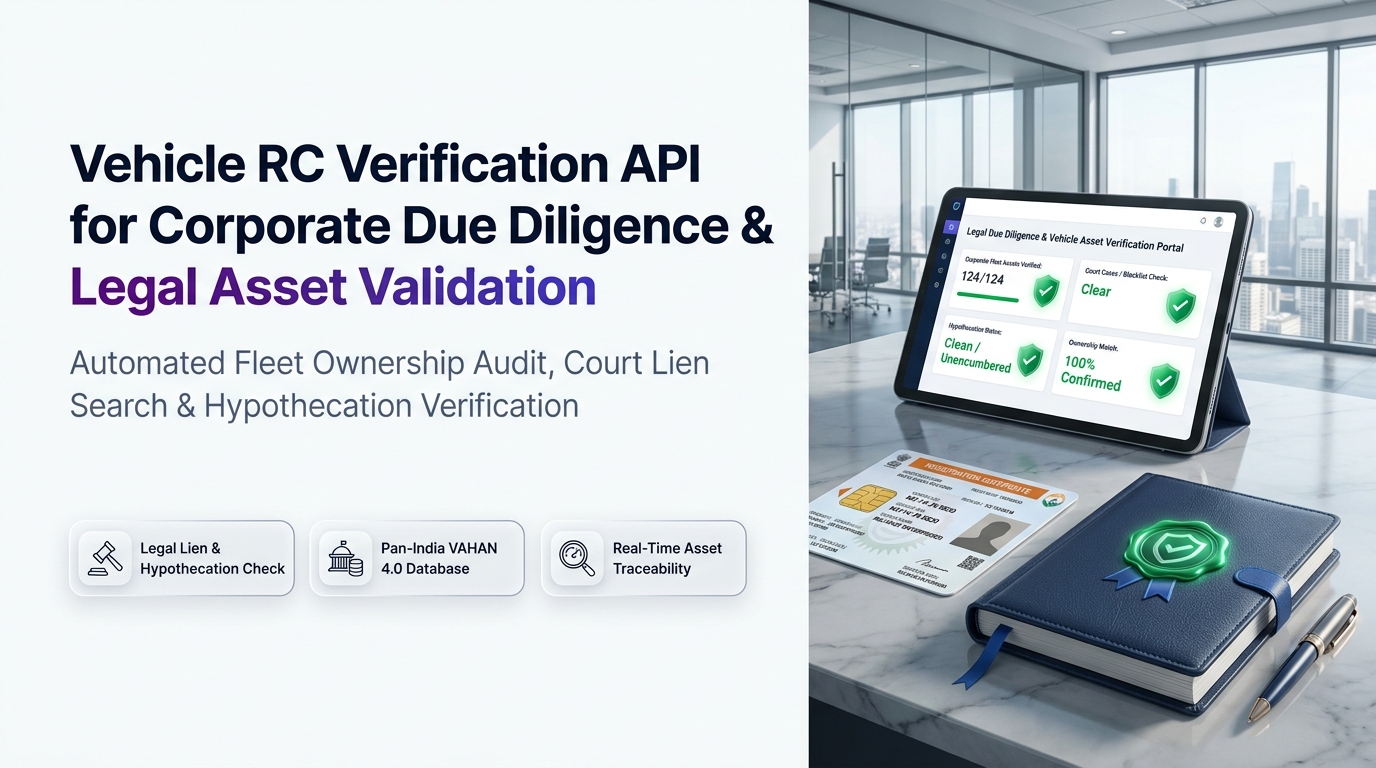
Vehicle RC Verification API for Corporate Due Diligence & Legal Asset Validation
The acquisition was supposed to close in six weeks. A mid-sized logistics company buying a smaller regional player, and the asset that justified the price was the fleet: eighty-two trucks, listed neatly in the information memorandum with model years and chassis numbers. The buyer's diligence team, which I was advising on data matters, decided to run every registration number through a Vehicle RC Verification API before anyone signed anything. It took one afternoon.
Eighty-two trucks on paper. The records told a different story. Eleven were registered not to the company but to the founder's brother personally. Nine carried hypothecation entries for loans the seller had described as "fully closed." Three registrations had lapsed fitness so long ago the vehicles legally shouldn't have been on the road, and two registration numbers returned records for entirely different vehicles, a tanker and, memorably, a scooter.
The deal didn't die. It got repriced, by a number with two crores in it, and the seller suddenly remembered a great deal about his own fleet. That afternoon of API calls was the cheapest work the diligence team did all quarter.
Why fleets lie on paper
Nobody should be surprised by this, and yet everyone is. Vehicles are the most casually documented major asset an Indian company owns. Land has title chains and registrars. Machinery sits inside audited books. But vehicles get bought in a founder's name for an early loan, transferred informally, financed and refinanced, and the company's fixed-asset register quietly stops matching the registration records. Years later that gap surfaces at the worst possible moment: an acquisition, an insolvency proceeding, a court-ordered asset attachment, or an insurance claim on a truck the company doesn't legally own.
Vehicle RC verification is how the gap gets found. The registration record returns the registered owner's name, maker and model, registration date, fitness validity, and any hypothecation entry, the current legal state of the asset, not the state the spreadsheet remembers. Run that against a fleet list and every mismatch is a question the seller has to answer before the money moves instead of after.
Vehicle RC verification for corporate due diligence
The reason vehicle RC verification for corporate due diligence has become standard practice in asset-heavy deals is arithmetic. A diligence team checking records manually can do maybe a dozen vehicles a day, and deals involve hundreds. An RC verification API does the whole fleet in an afternoon and returns structured fields your team can sort: owner-name mismatches in one pile, HP entries in another, lapsed registrations in a third. The lawyers then spend their expensive hours on the twenty-five problem files instead of the eighty-two total files.
The same mechanics serve the legal side. In insolvency and recovery matters, a vehicle ownership verification API for legal asset validation answers the court's actual question, what does the debtor legally own today, with records rather than affidavits. Lawyers I work with have used vehicle ownership verification to establish that assets claimed in a settlement offer were registered to relatives, which changed the negotiation considerably. When ownership is the dispute, the registration record is close to the whole argument.
One professional caution, the same one I give lenders. A mismatch is a question, not a verdict. Fleets legitimately contain leased vehicles registered to lessors, vehicles mid-transfer after a genuine purchase, and old HP entries nobody filed the closure for. In the logistics deal, six of the eleven founder's-brother trucks turned out to have a defensible history; the repricing came from the other five and the phantom loans. The API sorts facts from claims. Humans still sort innocent from otherwise.
Choosing the API for diligence work
A vehicle verification API for businesses doing diligence has slightly different needs than one wired into a loan origination flow, and it's worth being deliberate. Batch capability matters most, you're checking hundreds of numbers in a session, not one at a time. Structured exports matter because the output lands in a diligence report, so fields, not PDFs. Distinct response states, found, name mismatch, HP present, not found, are what let you sort the piles. And logging matters doubly here: a diligence file may be examined in court, so every check needs its timestamp and reference intact. Our RC verification basics covers the underlying check, the banking version covers collateral workflows, and the API security guide covers the data-handling discipline. For deal-side context, the IVCA, the industry body for private capital in India, publishes useful material on how diligence practice is evolving.
The best vehicle RC verification API for corporate due diligence is, bluntly, the one whose output your lawyers can drop into a disclosure schedule without reformatting, from a vehicle registration verification API provider who can demonstrate audit-grade logs on a demo call.
Conclusion
The repriced logistics deal closed, and the buyer now runs the same check annually on its own fleet, because the lesson cut both ways: if a seller's registers drift from the records, so do yours. That's the real takeaway. An afternoon with a Vehicle RC Verification API converts a fleet from a claimed asset into a verified one, before an acquisition, during a dispute, or just before your own auditor asks. Two crores of repricing against a few hundred rupees of API calls. In diligence, you rarely get odds that good.