
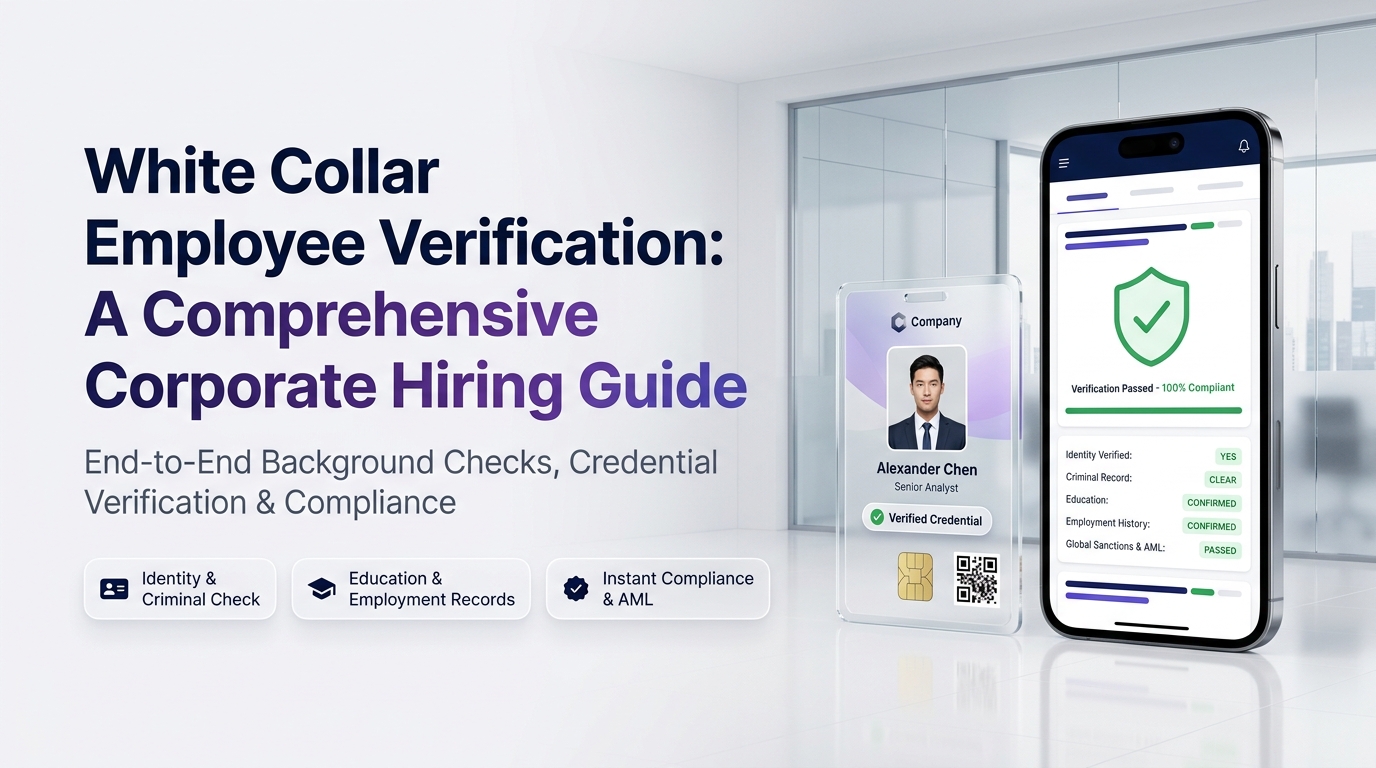
White Collar Employee Verification: A Comprehensive Corporate Hiring Guide
The message landed in the HR WhatsApp group at 9:47 on a Wednesday night, which tells you everything about how the rest of that week went. Our verification partner had just sent over a report on a candidate the business had been chasing for two months. Senior operations role. Three interview panels had loved him. The report said his longest job on the CV, the one everyone kept quoting in the offer discussions, had lasted eight months. Not three years. The employer name checked out. The dates did not.
By Thursday lunchtime we'd found two more problems on the same file, a title inflated by a full band, and a reason for leaving that didn't survive a single phone call. The offer got pulled on Friday. Nobody felt clever about it. Everyone felt relieved.
I've told that story a few times since, and other HR people usually nod and have their own version. What's also interesting is how few of those companies had a real programme for it. They had a checklist item marked "BGV." Nobody owned white collar employee verification.
Why the senior hires are where the damage happens
Here's the pattern I see again and again. The blue-collar side is buttoned up. Guards, drivers, warehouse staff, all get checked, because the compliance calendar forces it. Then a company hires someone into a role with pricing authority, client access, and financial systems, and the process basically amounts to "we liked him in the interview."
Think about who that interview is testing. White collar candidates are, by and large, professionals at being evaluated. They've done dozens of interviews. They know which employers sound credible, how to explain a short stint, how to answer the awkward question with confidence. Junior people exaggerate clumsily and trip themselves up. Senior people exaggerate with polish, and polish is exactly what you're hiring them for, so it slips past. Corporate employee verification exists to check the one thing the interview structurally cannot: whether the facts underneath the performance are real.
What actually gets verified
A real employee background check for a white collar hire covers a fairly predictable set of things. Employment history is the big one, because that's where the embellishment concentrates. Former employers get contacted to confirm dates, designation, and sometimes salary range. Education gets verified directly with the institution, not against a scanned certificate, which matters more than people think given how easy a fake degree document is to buy. Identity and address get checked against the candidate's own documents. Court and criminal record checks run with written consent. References happen too, though I'll be honest about references: the candidate gives you numbers that will ring nicely. The number that never gets answered often tells you more than the one that does.
And it's not all about catching liars. Plenty of discrepancies are innocent: an acquired company answering under a new name, a typo in a joining date, a college that changed university affiliation. Fixing those before day one beats explaining them in an audit.
How it gets done without slowing hiring down
Most companies that try running this in-house give up within a year. The checks aren't hard to understand. The network is hard, contacts across HR teams, universities, and local offices in dozens of cities take years to build. That's what established employee verification services sell, along with the consent paperwork in-house attempts usually botch. Professional corporate background verification services turn a six-week chase into roughly a six-day report.
The modern version plugs into your ATS or HR system. An employee verification API kicks off the checks the moment the candidate submits details in onboarding, captures consent digitally, and writes the result back against the candidate with a status your team can actually route. Cleared, discrepancy, pending, employer unreachable. For teams asking how to verify white collar employees without stalling an offer the business wants signed this week, that routing is the whole answer: the check is automatic, the exception gets a human, and nothing waits in an inbox.
The privacy part
This is someone's personal life on a form, so consent comes first and means something. They know what's being checked, why, and who sees the output. And keep reports need-to-know. A hiring manager needs "cleared" or "there's a discrepancy to discuss." They don't need three years of the candidate's address history sitting in their inbox.
The National Skills Registry, maintained for the industry, increasingly holds verified professional records the candidate can authorise you to see. The data-handling ground rules are the same ones in our consent management notes and API security guide.
The cost argument
That pulled offer made someone do the maths properly. A senior hire who leaves, or is removed, inside six months costs somewhere between six months' and a year's salary once you count recruiter fees, a wasted ramp-up, and the team disruption around them. One of those events costs more than verifying every hire for years. After that calculation, the verification line stopped being the one people tried to trim.
Conclusion
Employee verification is nobody's favourite part of hiring. Candidates find it intrusive, HR finds it slow, hiring managers find it annoying when they want their person started already. All fair. None of it changes the economics.
White collar employee verification is cheap cover against the one hiring failure you can't unwind, a senior person inside your systems who never did the job on the CV. The practical recipe is simple enough: verify employment and education on every offer, take consent properly, lean on employee verification services or an employee verification API wired into your ATS, and keep reports locked down. The candidate who aces the interview still gets the job if the facts match. It just stops being decided at 9:47 pm in a WhatsApp group.